Showing posts with label French Polynesia. Show all posts

Sunday, January 3, 2016

Over the Rainbow: Bora Bora


"Ever since happiness heard your name, 
it has been running through the streets trying to find you."

                                                       --Hafiz

Happiness and I definitely had a meaningful encounter in Bora Bora.  


Like eating a good meal with a fine zinfandel, I wanted to savor fully this trip before writing about it. I had many delightful first impressions of Bora Bora, and it lived up to everything I had ever read about it. But of all the ports I visited, the Bora Bora afterglow—the memories and the euphoric feelings they evoke—has remained the longest.

Bora Bora, located about 160 miles northwest of Tahiti and approximately 2,600 miles south of Hawaii has long been the muse for artists, poets, authors, movies, and lovers. To say it is beautiful understates the truth. And, its charm emanates from a more sensual place, like a subtle perfume that conjures memories and hooks you into creating new ones.

So much beauty forces you to pay attention to every detail: the rich colors of the hibiscus; the turquoise blue waters of the lagoon that surround the main island; the waves that crash against the reef so intensely you can hear and feel them on the shore miles away; and the sun rising behind the famous volcanic mountains. 

The main island and its smaller siblings, completely surrounded by coral reefs, form a natural aquarium with some of the most spectacular snorkeling and diving in the world.

You can ride the 33 miles around the entire main island by bicycle. At many points I had the view all to myself; on the windward side of the island I basked in the sun as the slow lap of the waves seemed to whisper the wisdom of silence. In another spot a man burned hibiscus trimmings [not a great smell], and at another a man fished. Interestingly, the main island only has one sandy beach, so throughout the island boats are kept on elevated rafters away from the shore [see photo above]. On some parts of the main island, and also on the smaller ones, a few resorts have the famed over-water bungalows that look like mushrooms from a distance.

Music is as much a part of the Tahitian lifestyle as the ocean. One afternoon I joined a small boat tour given by a local named Mata and his son. As he drove us out to a private island he played the Tahitian ukulele while his son played the drum. The fast tempo of the Tahitian songs matched their positive attitude and playful energy. As we sat on the private beach eating fresh coconut and papaya, a rainstorm came in, threatening to ruin the day. We piled back in his boat to journey out toward the reef where the massive waves could be heard [and felt]. 
As we crossed the lagoon and I looked at the peaks of the main island, a rainbow magically appeared between them. Then, as if scripted, one of the group members started playing the ukulele version of “Somewhere Over the Rainbow.” The magic of that moment became permanently etched in my memory.


Despite the chill the storm brought to the water and air temperatures, I decided to swim with the lemon sharks in the lagoon. The visibility in the clear water allowed us to watch the sharks as they appeared to glide through the water. Although I have done shark dives in the past, this experience felt more relaxed and casual, with each moment filled with gratitude more than fear.  A little while
later our group swam with manta rays, which seemed just as playful as our guide. The ride back into the lagoon, singing songs and watching the sun set, felt like a dream. I have so many more magical memories of Bora Bora, and I hope my pictures tell the story in a way that words cannot.
Barbecue Bora Bora style

Saturday, January 2, 2016

Raiatea, Tahiti, French Polynesia


 “Beware of killer coconuts.”  This helpful advice comes from Vivien, the guide for a kayak trip up Fa'aroa, the only navigable river on the French Polynesian island of Raiatea. In addition to the rain and the ubiquitous mosquitoes, I must also be on the lookout for brown coconuts on the overhanging palms—at any moment one could fall and cause an early, and somewhat embarrassing death.

The rain has churned up the river so the water lacks the clarity of the blue ocean into which it eventually runs. The landscape does not disappoint, though: A lush canopy of vegetation—papaya, bananas, bread fruit, hibiscus, and palms—against a magnificent background of verdant mountains with cragged peaks and ridges, blanketed in clouds. The rhythmic paddling and the soft sounds of the river current bring a hypnotic feeling to the journey.

Raiatea, the second largest island in the Society Islands, means “bright sky” or “faraway heaven” in Tahitian.  Many cultures believe Raiatea is the original birthplace of Polynesia and from here the great migration led to the colonization of Hawaii and New Zealand. This belief makes Raiatea a place of pilgrimage for many Polynesians throughout the South Pacific.

In the main town, a sleepy little seaside village, the plaza has a local market with fresh fruits, crafts,
and fragrant tropical flowers, including ginger and the delicate white tiare flower, the same symbol of which adorns the famous Tahitian Hinano beer. Fresh flowers have been woven into leis that adorn women’s heads and necks and match their brightly colored pareos.  The dancers quickly shimmy their hips to the fast-beating drums and the faster Tahitian ukuleles.

 Raiatea shares a large blue lagoon and surrounding coral reef with a smaller sister island, Taha'a, which is known for its vanilla farms.  A few blocks from the plaza, down an unmarked street next to the post office, a steep but bucolic trail leads to Tapioi Hill, with
stunning views of the Taha’a, the lagoon, and the surrounding reef. After greeting chickens, dogs, pigs, goats, cows, and horses, I am standing next to radio towers viewing clouds and mist. It was worth the effort, though, to see why this island is named “faraway heaven” when I feel like I’m on top of the world. The scent of vanilla, gardenia, and ginger will always take me back to this beautiful day on that tiny peak of paradise.


Thursday, December 31, 2015

Roots: Taiohae, Nuku Hiva, Marquesas Islands


Got out of town on a boat goin' to Southern islands
Sailing a reach before a followin' sea
She was makin' for the trades on the outside
And the downhill run to Papeete

Off the wind on this heading lie the Marquesas
...

You understand now why you came this way
'Cause the truth you might be runnin' from is so small
But it's as big as the promise, the promise of a comin' day

                                                                                    Southern Cross by Crosby, Stills & Nash


As a child reading Nat Geo magazines, I dreamed of becoming an anthropologist traveling to some mystical  place learning about new cultures and perhaps, myself, in the process.

Almost 40 years later I’m standing on the deck of a ship that has carried me across the South Pacific Ocean for over six weeks. Although I had already seen incredibly beautiful islands, as the sun rose through the mist while approaching Nuku Hiva, an inexplicable excitement stirred within me.

On one side of the ship lie untamed mountains with jagged edges and indentations forming ominous faces and figures in the shadows. On the other side, the partially submerged rocks collectively resemble a fat man lying on his back exposing his chin and belly toward the sun. The sun’s rays poke through the clouds, highlighting parts of the mountain and the moored sailboats sprinkled throughout the harbor.

The air feels electric with anticipation.

And then I feel the drums--deep, carnal, visceral, tribal, and hauntingly familiar.
They rattle my bones and stir my blood as if an untethered cord within me has been waiting until this visit to connect me to my roots and my story. Here, in this wildly beautiful island, I have found one of the few places that I feel rooted.

Arriving on shore I wondered what the explorers must have felt hundreds of years ago when they first arrived if they received the same welcome. The massive drums, carved from tree trunks and covered with animal or sharkskin, resonate in your bones. The dancing lifts your spirits, and the singing shifts from playful to wailing.

Nuku Hiva, the largest island of the Marquesas, has natural majestic beauty in its soaring spire-like mountain peaks, secluded valleys, and waterfalls. It also has an interesting heritage. Some studies suggest the earliest discoverers came from Samoa 2000 years ago. Over time the population exceeded the available resources. Notably, cannibalism was observed and documented by the missionaries, and different theories have attempted to explain why many Polynesian tribes adopted the practice.

Like many other ports, the churches re-directed part of the island’s history. Nuku HIva, though, still has many ancient sacred sites with petroglyphs—remnants of their previous beliefs carved into stone. Other parts of the island are currently being excavated for the ancient relics from sacred sites.

At one such site, I could see and hear powerful waves slamming into the rocks. Then, as the water receded over the lava rocks and pebbles I could hear a soft little melody. This contrast offered a beautiful metaphor for the ebb and flow of life. As ancient as the petroglyphs are, a visible spiritual reverence appears in the stones, as well as in the other tikis and carvings observed throughout the island. Spirituality speaks to our soul’s connection to heaven and earth, and each other, through our heart. Regardless of location or time, we are spiritual beings having a human experience. We are all connected.

People here appear happy and peaceful, acquiring all they need from the land and sea. The tales of their life and their values, their connection to the earth and each other can be seen permanently memorialized in the designs of their tattoos. As I walked along the black sandy beaches sparkling with mica-like gold flecks, I observed one man washing his horse under a palm tree and another playing with his dogs in the ocean.  I saw families swimming and barbecuing by the ocean, and musicians hanging out playing the Tahitian ukulele. At the market craftsmen displayed their hand-carved woodwork and women sold handmade shell and pearl jewelry. People laughed and shared papaya, mangoes, and coconuts. And everywhere there were flowers. The women wear fragrant flowers like frangipani or tiare (gardenia) as garlands and head bands, and the vibrant colors of flowering trees can be seen everywhere you walk.


The lyrics of CSN’s Southern Cross ring true: I understand now why I came this way.

Wednesday, December 30, 2015

Tahiti, French Polynesia: Pape'ete & Mo'ore'a


Pape’ete, Tahiti, French Polynesia


**French Polynesia encompasses 5 groups of islands: The Society Islands archipelago; the Tuamotu Archipelago [see Blog about Rangiroa]; the Gambier Islands; the Marquesas Islands [see Blog about Nuku Hiva]; and the Austral Islands.


Tahiti, located within the Society Islands archipelago, is the largest and most populated of the islands. Tahiti’s mountain peaks reach upwards to 7300 feet and house lush valleys, rainforests, waterfalls, and abundant flowers and fruit.

The bustling port capital, Pape’ete, resembles a large metropolitan city rather than the romantic swaying palm trees and grass huts I was expecting. 


 In contrast to the swaying, smooth, gentle wave-like hula moves of Hawaii, the Tahitian dance and music pulses quickly with a fiery rhythm like a volcano. It is electric and tribal, and I saw this reflected in much of the graffiti scattered throughout the city.


The hustling energy of the city shows up in the Central Market where locals sell traditional Tahitian crafts, flowers, fruits, fish, and everything in between. And given the French influence, the city does not lack outdoor cafes, coffee, and fresh baguettes. Although it was not the romanticized island landscape I have envisioned, this big city has its own personality and charm.
 In addition to French culture, the Polynesians have woven Indian and Chinese influences into their cultural tapestry. Glimpses of the Polynesian roots can be seen in the common areas, though. For example, a botanical garden and culture center; the vaka [canoe] recreational area; a tattoo parlor specializing in local artistry. And, the graffiti.


Mo’ore’a, Tahiti

  
When I close my eyes to picture the most idyllic place to live, my memories from here would fill my heart and mind. Mo’ore’a is Pape’ete’s beautiful sister. In contrast to the frenetic tempo of Pape’ete, Mo’ore’a’s calm demeanor reflects in her lush green mountains rising majestically over tranquil inlets harboring sailboats.

This heart-shaped island formed over a million years ago from a volcano. Originally, the island’s poetic name, Aimeo I Te Rara Varu depicted the eight majestic mountain ridges of her landscape. A high priest’s dream in later years led to the current name, which means “yellow lizard.” Natives of Pap’ete and Mo’ore’a each claim their island as inspiration for the mythical Bali Hai based on the Michener novel about the South Pacific. The jagged peaks and lush landscape complement the beautiful white sand beaches and electric blue water. 

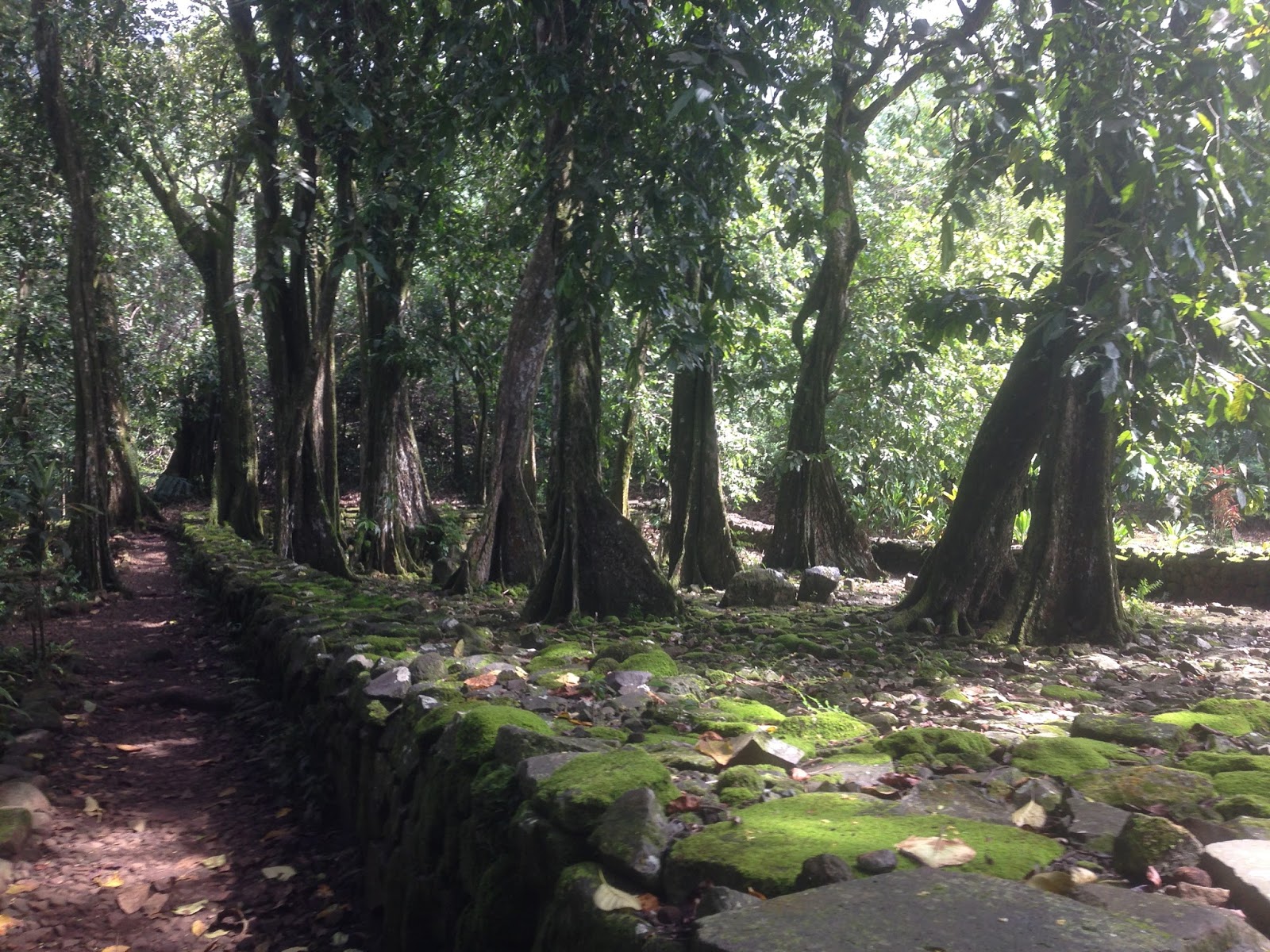
You can circumnavigate the island via a 40-mile stretch of winding road, promising beauty and majesty at every turn.  From every viewpoint the mountains beckon you to hike them. When you do venture into the hills, you find some remarkable ancient landmarks, called marae, on which ancient stone rocks shaped like pyramids contain carvings that detail the occurrences of sacrifices. 
Marae
 Belvedere lookout, perched in the mountains between Cooks Bay and Opunohu Bay, offers breathtaking views of the ocean and the majestic peaks.


Early in the day I ventured along a local road observing chickens  and dogs wandering the streets and delivery boys bringing freshly baked baguettes [it is French Polynesia ,after all] to homes by bicycle. Although no official town exists on the island, areas along the road have a few stores selling local crafts, sarongs [pareos] and fresh fruit. Noni, papaya and mango trees, overloaded with fruit, are everywhere.
Bliss